

Emotional intelligence has emerged as a vital workplace skill, and testing and improving EQ skills has become a popular development tool for individuals and organizations. You can find online quizzes for just about anything these days, and EQ is no exception. But not all emotional intelligence self-assessments are made equal, and the online landscape can be overwhelming.
As the leading provider of EQ solutions and services for organizations worldwide, we want to help you navigate the world of emotional intelligence quizzes, questionnaires, and assessments so you can choose the right solutions for your needs and the needs of your organization.
What is Emotional Intelligence and Why Does it Matter?
Before we get into assessments, let’s talk about emotional intelligence and why measuring it is so important for success.
Emotional intelligence (EQ) is the ability to recognize and understand emotions in yourself and others and use that awareness to manage your behavior and your relationships. While not a skill typically listed in job descriptions, decades of research have proven it to be a key driver of success in individuals, teams, and organizations.
Don’t just take our word for it. TalentSmartEQ’s own research from decades of data shows that 90% of top performers are high in EQ. A meta-analysis in the Journal of World Business found a strong positive link between leader EQ and employee performance. And a study out of the University of Edinburgh confirmed a strong positive link between team members’ EQ and team performance.
Unlike IQ, which is relatively fixed throughout your life, EQ can change over time. It can be improved with the right training and tools, but only if you know what needs to be improved. Self-assessments can help you identify which emotional competencies need development so you can focus your learning efforts.
For the curious employee, an EQ test is a helpful tool to gain insight on how to improve at work. But for discerning leaders and organizations, EQ assessments, if used well, become a strategic asset that leads to sustained improvements in company culture, employee productivity, and overall organizational success.
How Do Emotional Intelligence Self-Assessments Work?
Emotional intelligence may be abstract, but assessing it doesn’t have to be. A good self-assessment brings the invisible into view by spotlighting how you handle pressure, empathize with others, and navigate emotionally charged moments. While some tools offer a quick snapshot, the best EQ assessments break down your emotional skills into clear, actionable components.
Most self-assessments use structured questions to evaluate how you perceive and manage your emotions and those of others. The goal isn’t to judge, but to give you a baseline of where you’re strong and where you can grow. A well-designed self-assessment can offer crucial insight into your current EQ and the steps you can take to improve it.
Key Components Measured (Four Core Skills)
A short EQ questionnaire may give you an EQ score and a few quick insights. But a high-quality emotional intelligence assessment will break down your score into the key components of EQ so you know where you stand with each.
TalentSmartEQ’s assessments measure EQ using four core skills:
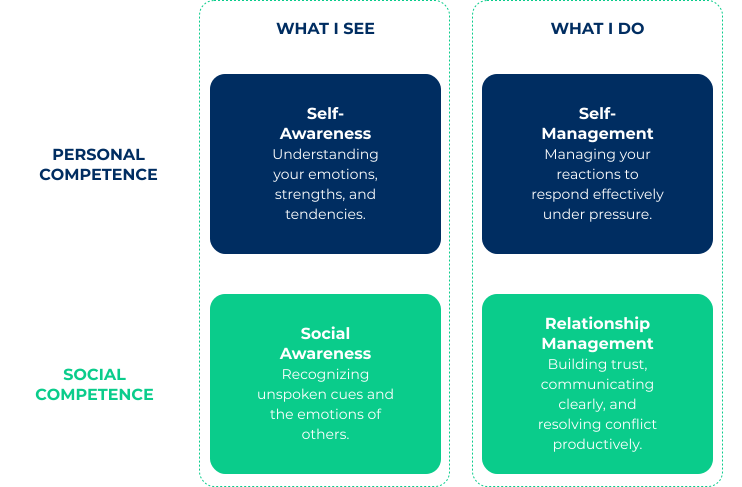
- Self-awareness is your ability to recognize your emotions as they occur. High scorers in this area can identify emotional patterns and what triggers them. Low scorers may struggle to understand why they act the way they do and how their emotions affect their actions and reactions.
- Self-management is how well you control impulses, stay composed, and adapt under pressure. High scorers tend to keep their cool in stressful situations and bounce back quickly from setbacks. Lower scorers might struggle with reactivity or inconsistent follow-through.
- Social awareness is the ability to pick up on the emotions of others. High scorers can tune into tone, body language, and other nonverbal cues from people around them. Lower scorers may be unable to “read the room” and realize when emotions are running high.
- Relationship management is how well you use the other three skills to manage interactions successfully. High scorers know not just what to say, but when and how to say it, and they recognize the importance of building trust. Lower scorers may steamroll others and struggle with conflict, whether by avoiding it or heightening it.
Taking an EQ Self-Assessment: What to Expect
Most emotional intelligence self-assessments use a simple but powerful format using a series of statements that you rate on a 6-point scale (ranging from “strongly agree” to “strongly disagree” or “never” to “always”). A typical test guides you through 25-50 statements, which is enough to begin to reveal your habits and behaviors across the core EQ skills.
For example, you might be given the statement “I avoid people I’m in conflict with.” You’ll then pick the answer on the scale that feels most true to you: never, rarely, sometimes, often, almost always or always.
Once you’ve answered all questions, most assessments will provide immediate results with some sort of explanation. A free quiz might give you a brief summary of your scores, while a full-length professional test often provides detailed breakdowns, actionable insights, and practical strategies for building EQ.
TalentSmartEQ’s Emotional Intelligence Appraisal – Self-Edition can be completed in as few as 5-7 minutes and includes a detailed report with your score profile, reflection questions, recommended strategies, goal tracking, and full access to our online development plan and resources.
Tips for an Accurate Self-Assessment
To get the most out of your self-assessment, follow these five best practices:
- Be honest. Resist the urge to choose the best answer and choose the truest one.
- Pick the right time. Take the assessment when you’re calm and focused, not rushed or emotionally triggered.
- Think in patterns. Answer based on how you typically behave, not based on one-off situations.
- Don’t overthink it. Your gut response is often the most accurate.
- Reflect afterward. Use your results to pinpoint what surprised you and where you want to grow.
Beyond Self-Assessments: Inviting Feedback from Others
While a self-assessment can give you reliable, actionable results if answered thoughtfully and honestly, even the most self-aware individuals have blind spots. To get a more comprehensive understanding of your emotional intelligence, you need the insight and perspectives of the people around you.
360° assessments combine self-assessment with anonymous feedback from those you work with on a regular basis. Feedback from others is the most effective way to increase your self-awareness and expose gaps between your self-perception and how you are perceived by others.
TalentSmartEQ offers two 360° assessments that present results in different ways based on the type of feedback you’re seeking. Our Multi-Rater Appraisal compares how you see yourself to how everyone else sees you in a simple but detailed report, while our 360° Appraisal gathers feedback from up to four groups of raters for a more robust report with unique perspectives from different groups. We also offer a 360° appraisal specifically for leaders, 360° Refined, which measures the 22 most important skills for leadership success.
Here’s a quick comparison of self-assessments vs. 360° assessments:
| Feature | Self-Assessment | 360° Feedback |
| Perspective | Self only | Self + others |
| Depth of Insight | Personal reflection | Balanced, multi-angle view |
| Ideal For | Individuals exploring EQ | Leaders & teams seeking growth |
| Common Use | Initial EQ awareness | Coaching, leadership development |
Interpreting Your EQ Score and Next Steps
You’ve taken your EQ self-assessment. Now it’s time to understand what your results mean. While many results come with detailed explanations of your scores, it’s up to you to use this new knowledge about yourself wisely.
In general, high scores in a particular area point to consistent emotional competence in that domain, and low scores indicate opportunities to build new habits and strategies. Resist the temptation to pat yourself on the back too much for high scores or beat yourself up for low scores. Emotional intelligence tests aren’t meant to be used as a judgment, but rather as a diagnostic tool to help you improve. Your scores are a starting point for development, and how you use the insights you’ve gained will be the difference between growth and stagnation.
What Your Results Mean
Most EQ tests will give you a score for each emotional intelligence component to help you categorize areas of competence and potential for growth. Real insight often lies in the gaps, especially if you’re strong in one area and lagging in another. For example, high self-awareness without strong self-management could mean you know what you’re feeling but still struggle to regulate it.
Here’s a quick reference to help interpret your scores:
| EQ Skill | High Score May Indicate | Low Score May Indicate |
| Self-Awareness | You recognize emotions early and understand their impact. | You’re surprised by your reactions or unaware of emotional triggers. |
| Self-Management | You stay calm under pressure and recover quickly. | You react impulsively or struggle to regulate stress. |
| Social Awareness | You pick up on tone, body language, and other nonverbal cues. | You miss emotional cues or struggle to read the room. |
| Relationship Management | You navigate conflict and inspire others effectively. | You avoid tough conversations or have strained conflict. |
Remember, scores offer a roadmap, not a label. EQ is highly trainable, and with the right resources at your disposal and a growth mentality, those scores will eventually be just a memory (bonus: TalentSmartEQ’s assessments offer a free re-test when you’re ready to measure your progress).
How to Put Your Results into Action
The best way to benefit from the results of your self-assessment is to come up with clear goals and develop a strategic plan to reach them. While some assessments, like our Self-Edition, offer these deliverables along with your results, other EQ tests might leave you to your own devices.
Here’s a simple framework you can follow for setting and working toward goals:
- Identify a focus area. Choose the EQ domain with the most room for improvement.
- Set a specific goal. Make it measurable (e.g. handle feedback without becoming defensive).
- Choose your strategies for improvement. Journal, practice mindfulness, ask for feedback, etc. (our book Emotional Intelligence 2.0 offers 66 strategies for improving EQ, if you need ideas).
- Track progress. Reflect weekly, logging observations, triggers, and lessons learned.
- Get support. Share your goal with a mentor, coach, or peer who can encourage you and hold you accountable.
Improving EQ is like building muscle – it takes commitment, effort, repetition, and time. And change may not be easily visible because it’s incremental. Until you look back from where you started, you might have trouble noticing progress. But as decades of success stories at TalentSmartEQ have shown, your efforts will pay off over time. If you want to be able to see your results more clearly, schedule regular check-ins with yourself where you take note of meaningful growth, complete another self-assessment after six months of training, or consider taking a 360° assessment to get a fuller picture of where you stand.
And remember, EQ development is never “finished.” It’s an ongoing process of reflection, learning, applying, and repeating where there’s always room for growth.
How TalentSmartEQ Can Help Your Organization
Emotional intelligence isn’t just a personal development tool. It’s a strategic business advantage, and organizations that prioritize EQ benefit from stronger leaders, more cohesive teams, and cultures that thrive under pressure. The ROI of EQ is clear, and the first step toward developing a high-EQ culture is assessing your organization’s current emotional intelligence.
If your business is interested in implementing our self-assessments on an organizational level, contact us to find out the best assessments for your specific needs. If you’re looking to dip your toes in the self-assessment waters, TalentSmartEQ offers an introductory version of our self-assessment with the purchase of our book Emotional Intelligence 2.0, which includes a PDF report of your results.
FAQs
Are EQ tests reliable?
When designed based on research and validated by data, EQ tests can be very reliable. However, there are many tests online that are not research-based, which is why it’s important to choose the right assessment. Reliability also depends on the honesty and self-awareness of the individual taking it, and 360-degree tests can improve accuracy by bringing in outside feedback.
What’s the difference between a self-assessment and a 360° EQ assessment?
A self-assessment reflects your own perception of your emotional intelligence, while a 360° assessment includes feedback from peers, direct reports, and managers for a more holistic view. Self-assessments are helpful for initial awareness, but 360s can uncover blind spots and give a fuller picture of your EQ.
Can EQ be learned?
Yes. Emotional intelligence is a highly flexible skill that can be learned with the right knowledge and strategies. The first step toward improving EQ is gaining awareness of where your skills stand currently, which is why assessments are the best place to start. Once you know what needs improvement, small, intentional practices coupled with feedback and reflection can begin to increase EQ skills. To ensure real, measurable results, investing in training or coaching is the best course of action.
Why does EQ matter in the workplace?
EQ is linked to nearly every critical aspect of workplace success, from managing stress and making decisions under pressure to navigating conflict and building trust. Research shows that 90% of top performers have high EQ, and companies that prioritize EQ development see improvements in retention, team dynamics, and leadership effectiveness, all of which have a meaningful impact on organizations’ bottom lines.